
Social media is currently filled with a lot talk, tips and tricks around combatting high cortisol levels, but how much merit is in this latest health and wellness trend and should you believe all the social media hype?
While cortisol can affect things like our weight, sleep, and blood pressure, a quick-fix supplement solution touted by a social media influencer isn’t the way to address any health concerns you may have around cortisol.
In this month’s blog, we take a more scientific look at cortisol’s impact on your health and how to address any issues that arise when you have too much or not enough of it.
What is cortisol?
Cortisol is an essential hormone that is produced by your adrenal glands and regulated by your pituitary gland. The pituitary gland sends the signal to your adrenal glands to indicate how much cortisol it needs to produce.
It is essential to a healthy life and has a number of important functions, including helping your body to:
- respond to stress or danger
- increase your metabolism of glucose
- control your heart rate and blood pressure
- reduce inflammation
- grow and develop an unborn baby
It is also the hormone that helps protect us from perceived dangers and prompts our fight or flight response to potential threats. It’s often known as the ‘stress’ hormone, as the body tends to release more cortisol into your bloodstream when you do feel stressed.
The release of cortisol can be influenced by a range of factors, including:
- very warm or cold temperatures
- infections
- exercise
- traumatic or stressful events
- obesity
- some health conditions
Usually your body will produce the right amount you need to keep you healthy. However, it can become a problem when your body produces either too much or too little. But how do you know if that’s the case?
Cortisol Symptoms – high and low
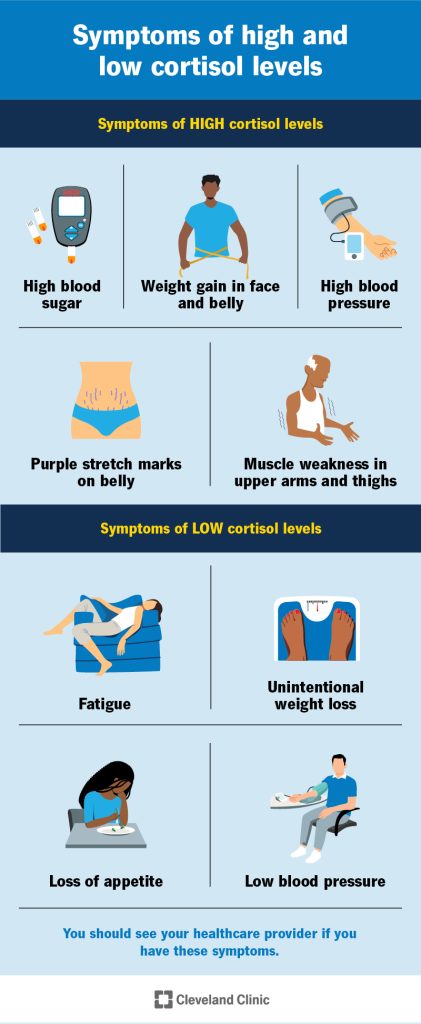
Too much cortisol can result in a number of both physical and emotional symptoms, including:
- weight gain, particularly around the abdomen and face
- thin and fragile skin that is slow to heal
- acne
- female facial hair and irregular menstrual periods
- reduced fertility
- depression and/or anxiety
- mood swings
- difficulty concentrating
- lower sex drive
Long-term exposure to high cortisol can lead to Cushing’s disease, where cortisol levels remain high all the time.
Additional symptoms of Cushing’s disease include:
- a rounded face
- a hump between the shoulders
- feeling tired and moody
- skin problems, such as wounds being slow to heal, bruising, and stretch marks on the tummy and thighs
While Cushing’s disease is rare, around 41 Australian’s are diagnosed each year and there currently between 300-1,600 Australians living with the disease. This fact sheet from the Australian Pituitary Foundation provides a good overview of Cushing’s Disease>>
At the other end of the spectrum, too little cortisol can produce symptoms such as:
- constant tiredness
- nausea and vomiting
- loss of appetite
- weight loss
- muscle weakness
- abdominal pain
Low cortisol that is the result of damage to the adrenal glands can cause Addison’s disease, where sufferers experience the additional symptoms of dark patches on their skin and craving salty foods. In Australia, ~2,500 people live with the disease and ~100 people are newly diagnosed each year.
Cortisol Treatments
With high levels often resulting from stress, most treatments will be aimed at adjusting lifestyle factors to reduce your stress levels. This may include:
- ensuring you are getting quality sleep
- moving your body and getting regular exercise
- practicing deep breathing exercises
- doing something that brings you joy and makes you laugh
- maintaining healthy relationships
For those with Cushing’s disease, treatment will also usually involve medication and possibly surgery.
People with Addison’s disease will need treatment with cortisone, to replace the cortisol that would normally be produced by the body naturally.

Getting a proper diagnosis
If you do have any symptoms of high or low cortisol, the most important thing to do is get a proper medical diagnosis – not potentially dangerous advice from the unregulated world of social media.
A proper medical diagnosis can confirm if there is an issues with your cortisol levels or if there may be something else causing your symptoms.
The first step for a diagnosis will be a blood test to measure your levels. As these will change throughout the day, you may need to have several blood tests at different times, to get a proper indication of exactly what is going on with your cortisol.
You may need to have additional blood tests, as well as saliva and urine tests, if your doctor suspects you have either Cushing’s or Addison’s disease.
If you are experiencing any symptoms or have any concerns about your health in general, please see your GP. To make an appointment at IMC, simply book online or contact us on (08) 9208 6400.
For more information on this topic, visit:
- ABC News Article, Why are so many people on TikTok trying to reduce their cortisol levels? – https://www.abc.net.au/news/2023-09-06/cortisol-content-is-everywhere-so-why-is-that-a-problem/102812244?utm_source=abc_news_web&utm_medium=content_shared&utm_campaign=abc_news_web&utm_content=mail
- Ausmed – https://www.ausmed.com.au/learn/articles/cortisol-production-use-body
- Better Health Direct – https://www.betterhealth.vic.gov.au/health/ConditionsAndTreatments/Hormones-cortisol-and-corticosteroids
- Health Direct – https://www.healthdirect.gov.au/the-role-of-cortisol-in-the-body
- Hormones Australia – https://www.hormones-australia.org.au
- The Society of Endocrinology – https://www.yourhormones.info/hormones/cortisol/
- University of Wollongong, Australia – https://www.uow.edu.au/media/2023/no-you-cant-blame-all-your-health-issues-on-high-cortisol-heres-how-the-hormoneworks.php